
If you’ve got solar panels on your NJ roof, you’ve probably wondered whether that layer of pollen, dust, and bird droppings is actually costing you money — or whether “solar panels are self-cleaning” is true. The honest answer sits in the middle, and it depends a lot on where you live and what’s landing on your roof.
Here’s the real breakdown from a NJ and NY metro exterior cleaning company — how much dirty panels actually cost you in output, when cleaning is worth it, and the one thing you should never do to a solar panel.
How Much Output Do Dirty Panels Lose?
Real-world numbers, not sales numbers:
- Light dust and general grime: 2–5% output loss
- Heavy pollen season (NJ spring): 5–8% loss
- Bird droppings, sap, or pollen left for months: 7–15%+ loss
- Panels near construction, busy roads, or trees: can hit 15–25% in bad cases
The U.S. Department of Energy has studied panel performance loss for years — its overview of solar performance and efficiency backs up the general range. The key point: a clean panel in NJ won’t dramatically out-produce a lightly dusty one. But a panel coated with months of pollen and bird droppings absolutely will.
Why “Self-Cleaning” Is Only Half True
Solar installers love to say panels are self-cleaning. Rain does rinse off loose dust — that part is real. But rain doesn’t remove:
- Bird droppings. These bake on and create dead spots that rain won’t touch.
- Tree sap and pollen film. Sticky, and it bonds to the glass.
- Dust that settles in the bottom edge. Water sheets off the panel and leaves a grime line along the lower frame that gradually creeps up.
- Pollen during a dry spring. If NJ has a dry, pollen-heavy April with little rain, that pollen just sits there reducing output for weeks.
So self-cleaning works for the easy stuff. It does nothing for the buildup that actually costs you the most output.
When Cleaning Is Worth It in NJ
- You’re under or near trees. Sap, leaves, pollen, and bird activity all concentrate here. This is the #1 case where cleaning pays off.
- You haven’t cleaned them in 2+ years. Buildup is gradual — most homeowners don’t notice the slow output drop until they see a clean-panel comparison.
- Your production numbers are dropping. If your monitoring app shows lower output than the same month last year (weather-adjusted), soiling is a likely culprit.
- You’re near construction, a farm, or a busy road. Airborne dust settles fast and heavy.
- You have a low-slope roof. Flatter panels don’t shed water and dirt as well as steep ones, so they soil faster.
When It’s Probably Not Worth It
- Steep roof, no trees, regular rain. If your panels are on a steep south-facing roof with no overhanging trees and NJ is having a normal rainy stretch, they’re staying reasonably clean on their own.
- You cleaned them last season and nothing’s changed. Annual is plenty for most NJ homes; twice a year only if you’re in a heavy-soiling spot.
For most NJ homes, once a year — ideally late spring after pollen season — is the sweet spot. Heavy-soiling locations benefit from twice a year.

The One Thing You Should Never Do
Never pressure wash a solar panel. We can’t say this strongly enough.
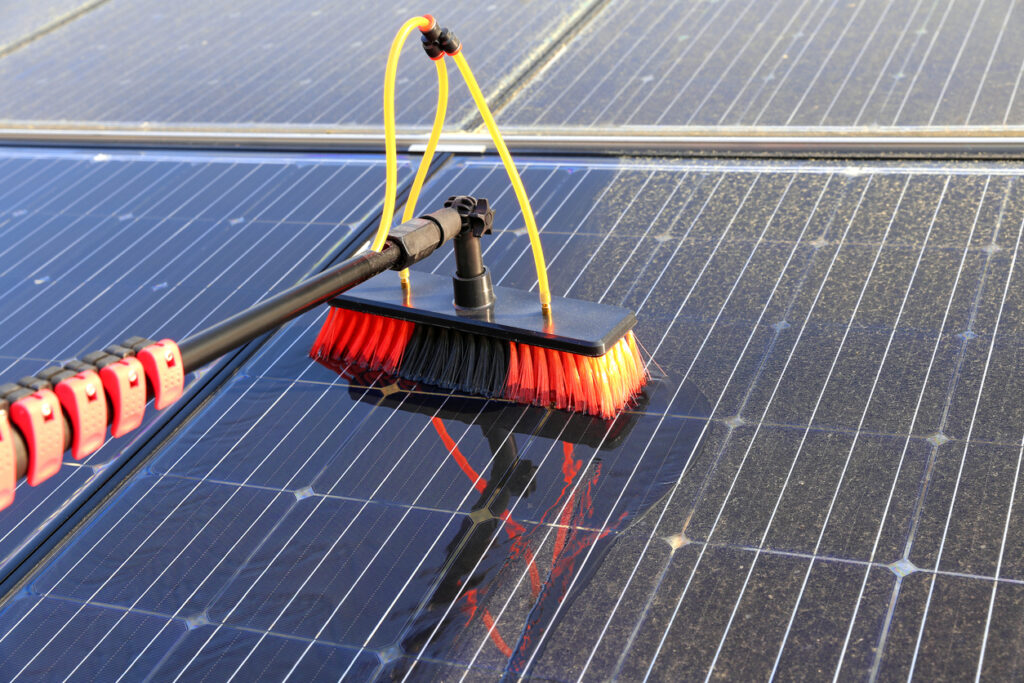
High-pressure water forces moisture past the panel’s edge seals, damages the anti-reflective coating, and can void your panel warranty instantly. The same goes for harsh chemicals, abrasive brushes, and metal scrapers. Solar panels get cleaned with soft brushes, deionized or purified water, and gentle technique — the same careful approach used for delicate glass, not the approach used for a driveway.
It’s also worth saying: getting on a roof to clean panels is dangerous, and many panels are wired with live DC current. This is not a great DIY project. A professional crew brings fall protection, the right water-fed pole equipment, and the experience to clean panels without stepping on them or damaging the array.
The Payback Math
Here’s the honest version. A typical NJ home solar array produces somewhere around 8,000–12,000 kWh a year. If dirty panels are costing you 8% output, that’s roughly 640–960 kWh a year — at NJ electricity rates (and factoring SRECs if you have them), often $150–$300 a year in lost value. A professional cleaning that costs a fraction of that and recovers most of the loss pays for itself, especially if you bundle it with other annual exterior work.
If your panels are only lightly dusty and you’re losing 2–3%, the math is closer to break-even — which is exactly why the “are my panels actually dirty” question matters before you book.
Bundle It With Other Roof and Exterior Work
The most cost-effective time to clean panels is when a crew is already at your house for other exterior work. If you’re booking a soft wash roof cleaning, gutter cleaning, or your annual residential window washing, adding the panels to the same visit saves a separate trip charge. The equipment overlaps and the crew is already set up for safe rooftop work.
The Bottom-Line Answer
Yes, cleaning your solar panels boosts output — but how much depends entirely on how dirty they are. If you’re under trees, near construction, dealing with bird activity, or you simply haven’t cleaned them in years, the output gain is real and the cleaning pays for itself. If they’re on a steep, tree-free roof and NJ’s been rainy, you can probably wait.
Not sure which camp your panels are in? Request a free estimate and we’ll take a look at your roof, your tree cover, and your soiling level before recommending whether a cleaning is worth it for your home — across Bergen, Essex, Passaic, Rockland, and Westchester.