
If you walked your property line this past weekend the way most North Jersey homeowners do in late April, you probably noticed a few things that weren’t there in October — gray streaks down the siding, gritty patches on the walkway, gutters sagging just a touch lower, and a film on the windows that doesn’t come off with a quick wipe. That’s the cumulative damage from one Northeast winter, and it’s the reason spring home exterior cleaning North Jersey homeowners do in April matters more than the cleaning you do in any other month. Here’s the realistic post-winter reset playbook — what to inspect, in what order, and which jobs can’t wait until summer.
What Six Months of Northeast Winter Actually Did
The damage from a North Jersey winter is layered. Each piece of weather adds a different problem, and they compound:
- Road salt from town plows lands on your siding, your walkway, and the bottom 2-3 feet of your house every time a truck goes by. By April, the bottom of your siding has accumulated a salt residue that pulls moisture from the air and slowly degrades the finish.
- Snow piled against the house traps moisture against siding and foundation walls for weeks at a time. When it melts, the wet zone becomes a perfect environment for the gray-black algae you see on north-facing walls every spring.
- Wind-driven debris — pine needles, broken twigs, leaves the rake missed in November — gets jammed into gutters, downspout strainers, and the corners where the roof meets the wall. By April, that debris has been wet for months and is starting to rot.
- Freeze-thaw cycles open up tiny cracks in pavers, masonry joints, and concrete walkways. Spring rain runs into those cracks and the cycle accelerates fast once daytime temps stay above 50.
- Ice dams in January and February may have pushed water under shingles or behind fascia. You won’t see the damage until it stains a ceiling or rots a soffit.
None of this is dramatic on day one. All of it gets significantly worse if you ignore it through April and May.
The Right Order to Tackle a Post-Winter Reset
The instinct most homeowners have is to start with whatever looks worst. That’s backwards. Exterior cleaning has a sequence, because each step generates debris that lands on the next step. Here’s the order that actually works:
1. Roof and Gutters First
Always start at the top. Clean the gutters of last fall’s leftover debris and any winter twig accumulation, then look at the roof itself for the dark streaks that signal algae or moss starting to take hold. North-facing roof slopes in Bergen and Rockland County are the worst for this — they get the least sun and stay damp longest in spring.
If you see streaks, a soft-wash treatment now stops the algae from spreading through summer. We covered the case for early treatment in our post on soft-washing your roof before fall — the same logic applies in spring, just for different reasons.
2. Siding and Exterior Walls
Next is the siding. The salt residue and algae growth from winter need to come off before spring pollen and summer humidity bake them on. Soft-washing is the right approach for vinyl, painted wood, and stucco — high-pressure power washing can actually damage these surfaces if the operator isn’t careful. The difference between the two is covered in our piece on soft washing vs power washing.
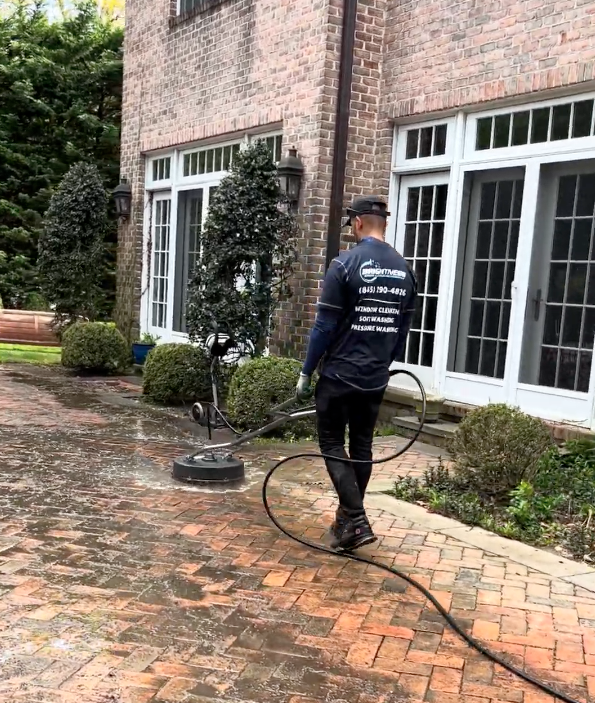
Hard surfaces — concrete walkways, brick paths, stone retaining walls — can take traditional power washing. That’s where you want the high-pressure setup. Mixing them up is the most common mistake homeowners make when they rent equipment from Home Depot.
3. Windows and Screens
Once the siding and roof are done, the windows are next. Doing windows before siding is pointless — the runoff from washing the siding lands on the windows you just cleaned. Pollen season is also ramping up in late April, so the timing for window cleaning has its own logic. We covered that in detail in our spring and summer window cleaning guide.
This is also when screens come out for their annual deep clean. Six months of winter dust and the start of pollen season means screens are doing real work right now and showing it.
4. Pavers, Walkways, and Hardscape
Walkways and patios go last because they catch the runoff from everything above. If you have paver patios or walkways, this is also the right time to look at whether the polymeric sand between the joints survived winter. If you can pour water between pavers and it disappears immediately, the sand is gone or compromised, and weeds will be coming up through those joints by Memorial Day. Re-sanding and sealing now is significantly cheaper than waiting until the weeds establish.
5. The Final Walk-Through
Once everything’s clean, walk the property one more time and look for the things that were hidden under winter debris — a cracked downspout, a loose piece of trim, a section of caulk that pulled away from the window frame. These are the small repairs that turn into expensive ones if they sit through another season of weather.
The Two Inspections Most Homeowners Skip
If you do nothing else this spring, do these two checks:
Run water down the gutters. Fill them at the upstream end with a hose and watch where it flows.
If you see overflow, the gutter has settled or a bracket has shifted. If water comes out of any seam, the seal failed over winter. Both are quick fixes now and not-quick fixes later.
Our piece on why clean gutters matter walks through what happens when these problems sit.
Look at the bottom 18 inches of every exterior wall. This is the salt and snow contact zone. If you see white residue, paint blistering, or any wood softness, that’s winter damage that needs attention before summer humidity makes it worse. Vinyl siding tends to hide this until it’s significant — pull a section away from the wall in a discreet spot and check the moisture barrier behind it.
Timing: Why Late April Through Mid-May Is the Window
The reason most professional crews do their heaviest residential work in late April and early May is that the weather finally cooperates. Daytime temperatures are warm enough that surfaces dry quickly between cleaning passes, but humidity hasn’t peaked yet, so soap residue rinses away cleanly instead of streaking.
Wait until June and you run into two problems. First, every reputable contractor in Bergen and Rockland County is booked 3-4 weeks out for residential exterior work by Memorial Day weekend. Second, summer humidity makes algae and mold growth on siding accelerate fast — the cleaning that takes one pass in May takes two passes in July.
The National Weather Service NY/NJ forecast is the right place to check the 10-day window before booking. Look for a stretch with no rain in the 24 hours after the scheduled clean — that gives soaps and treatments their full dwell time.
What to Bundle vs. What to Phase
Most full post-winter resets bundle nicely into two visits — one for the exterior soft wash + roof + walkways, and one for windows + screens. Splitting them across two appointments lets each crew do its job without working over each other, and it usually costs less than trying to schedule everything in one marathon day.
If your house is in Bergen, Rockland, Orange, or Northern Passaic County, the team at Brightness Window Cleaning handles the full reset across all of these counties — see our services overview for what’s typically bundled together. The full post-winter reset for a typical 2,000-2,500 sq ft NJ home runs $700-1,200 depending on roof and hardscape size, and it’s the single highest-impact maintenance spend of the year.
The Booking Reality Right Now
If you’re reading this in late April, you have maybe two weeks of easy scheduling left before the spring rush locks up the calendar. Most reputable North Jersey exterior cleaning companies are booking 7-14 days out for residential work, and that gap will hit 3-4 weeks by mid-May.
If you want a same-week post-winter assessment for a North Jersey home, the fastest route is our quote form. Mention what you saw on your spring walk-through and we’ll prioritize the order of work around what actually needs attention first.