

If you manage a Manhattan high-rise, you already know the glass gets dirty fast. The real question property managers ask us is simple: what is the right Manhattan high-rise window cleaning schedule, and how do you build it into an annual operating budget without overpaying or letting the facade get embarrassing?
Here is the short answer, then the reasoning behind it. Retail-facing ground floors should be cleaned quarterly at a minimum, standard commercial office towers should be cleaned semi-annually with seasonal boosts, and any building along a heavy-traffic corridor or near an elevated subway line should plan for a monthly touch-up on the lower five floors during salt and pollen season.
The Short Answer: Manhattan High-Rise Cleaning Cadence by Building Type
Every building is different, but after years of cleaning towers in Midtown, the Financial District, and the Upper East Side, the schedule we recommend to property managers looks like this:
- Retail-facing storefronts and lobby glass: every 4 to 6 weeks, minimum quarterly
- Standard Class A office towers: semi-annually (spring and fall), with an optional third cleaning after a hard winter
- Mixed-use and luxury residential high-rises: two full exterior cleanings per year, plus a spring interior pass
- Buildings on avenues with elevated subway lines or bus depots: monthly on the lower floors, semi-annually on upper floors
- Hotels and hospitality: quarterly across the whole facade, monthly on lobby and entrance glass
Those are baselines, not ceilings. If your building has a restaurant on the ground floor, a heavy delivery bay, or a construction project next door, you should expect to clean more often. If you want to see how we structure this for the buildings we already serve, our high-rise and commercial window cleaning service in NYC and NJ outlines the standard packages we quote from.
Why Manhattan Windows Get Dirty Faster Than Anywhere Else
If you have managed properties in suburban New Jersey and Manhattan, you already know the difference. A Class A tower on Sixth Avenue collects more visible grime in six weeks than a Bergen County office park does in a year. There are four Manhattan-specific reasons for that.
Winter road salt and calcium chloride
From November through March, NYC DOT and private contractors treat streets with rock salt and calcium chloride brine. Every passing truck kicks that mixture into the air, where it drifts up the face of buildings and dries onto glass as a chalky film. It is especially rough on the first ten floors of any building on an avenue. Left alone through spring, that salt film etches into the glass surface and becomes much harder to remove.
Diesel soot, construction dust, and HVAC exhaust
Manhattan runs on diesel deliveries and constant construction. Fine soot particles settle on any horizontal or vertical surface within a couple of blocks of a job site. Rooftop HVAC exhaust from your own building and your neighbors also drifts across upper-floor glass. This is why the top three floors of a tower can look almost as dirty as the ground floor, even without street-level splash.
Elevated subway lines and bridge approaches
If your building sits near the elevated 1 train in Inwood, the Manhattan approaches to the Queensboro or Williamsburg Bridges, or the Lincoln Tunnel helix, the exterior collects an additional layer of brake dust and rail grime. Buildings in those pockets typically need one extra cleaning per year compared to properties a few blocks inland.
Spring pollen and summer humidity
Late April through early June is peak pollen in the metro area. Yellow-green film coats every south-facing window in a week. Combine that with July humidity and the pollen bonds to the glass. A pre-Memorial Day cleaning is one of the most-requested seasonal jobs we run for Manhattan property managers.
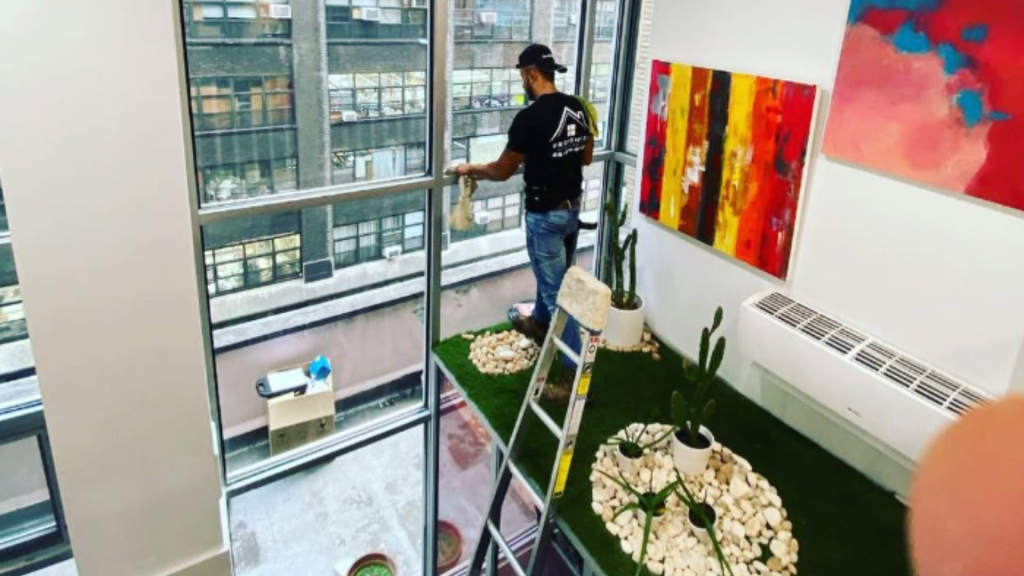
Retail-Facing Storefronts: Quarterly Is the Floor
If your ground floor is leased to retail, a restaurant, a bank branch, or a gym, treat the storefront glass as a marketing surface, not a maintenance item. Fingerprints, food splash, and street splash on a bank lobby window read as neglect to every person walking past. Most of the retail-heavy buildings we clean in SoHo, the Flatiron, and along Madison Avenue are on a four-to-six-week cadence for the ground-floor glass, with the tower cleaned separately on its own schedule.
Retail tenants often have language in their lease requiring the landlord to maintain the storefront exterior. If yours does, quarterly is the absolute minimum; monthly is what most Class A landlords deliver.
Standard Commercial Office Towers: Semi-Annual With Seasonal Boosts
For a standard commercial tower without heavy retail, the base schedule is two full exterior cleanings per year: one in March or April to strip off winter salt, and one in September or October to reset the facade before winter closes in. That is the minimum we recommend for tenant satisfaction and for the buildings we service through Brightness Window Cleaning.
Class A landlords in Midtown, the Plaza District, and Hudson Yards typically add a third cleaning in mid-summer to keep the building competitive at leasing tours. If your comp set is cleaning three times a year and you are cleaning twice, prospective tenants notice the difference on the walk-through.
Mixed-Use and Residential High-Rises: What HOA Boards Should Plan For
Condo boards and co-op boards ask us this constantly. The workable answer for most Manhattan residential high-rises is two full exterior cleanings per year, plus a coordinated interior cleaning pass in the spring for unit owners who opt in. The exterior work is paid from the common charges; the interior work is billed unit-by-unit.
Coordinating the interior pass around residents’ schedules is the hardest part of the job, not the cleaning itself. Boards that publish the cleaning dates 60 days in advance get much better unit participation and fewer complaints from residents who forgot the crew was coming.
How Local Law 11 Fits Into Your Cleaning Calendar
Every building six stories or taller in New York City is subject to the Facade Inspection and Safety Program, commonly called Local Law 11. That is a facade inspection requirement, not a cleaning requirement, but the two overlap in practical scheduling for property managers.
Two overlaps worth planning for:
- If your building has a Local Law 11 inspection coming up, schedule a full exterior window cleaning within 30 days beforehand. Clean glass makes it easier for the inspecting engineer to spot cracks, sealant failures, and stone erosion.
- If your building is in an active Local Law 11 sidewalk shed cycle, coordinate cleaning around the shed schedule. It is often more cost-effective to clean before the shed goes up and after it comes down than to try to reach lower floors around the scaffold.
Some property managers try to combine facade repair and window cleaning under one contractor mobilization. That can work, but the two disciplines require different insurance, different equipment, and different crew certifications. Ask any contractor bidding on both to walk you through how they handle the split.
Seasonal Push Points for Manhattan Buildings
A useful way to build the calendar is around three seasonal push points that every Manhattan building deals with.
Late March to mid-April: post-winter deep clean. This is the single most important cleaning of the year. Salt, sand, and winter grime have been building since November. Get this on the calendar in January so your crew has a slot when the weather breaks.
Late May to early June: post-pollen refresh. Pollen film on south-facing glass is the most-noticed issue in office buildings all summer. A single pass after the pollen bloom keeps the building looking crisp through August.
Early November: pre-holiday retail push. Retail-heavy properties want spotless glass for holiday window installations, storefront lighting, and the Thanksgiving-through-New-Year foot traffic. Book this by mid-September; the good crews are all committed by October.
If your building also has exterior brick, stone, or concrete that needs attention before winter, pair the November cleaning with a pressure-wash pass. Our guide to why you should pressure wash before winter walks through the reasoning for that timing.
Insurance, Certifications, and Scheduling Considerations
For any Manhattan high-rise work, the contractor you hire must carry current general liability, workers’ compensation, and disability insurance at limits your building requires. Rope-descent and suspended-scaffold crews also need to meet OSHA window cleaning safety standards for anchor inspection, fall protection, and equipment maintenance. Ask for the certificate of insurance, the anchor inspection report, and the crew’s most recent safety training records before the first job.
Scheduling in Manhattan is its own puzzle. Loading dock access, freight elevator windows, tenant notification requirements, and pedestrian sidewalk closures all have to be lined up. Most buildings we clean want work performed early-morning weekdays, on weekends, or overnight so tenants and pedestrians are not disrupted. Confirm those hours with your contractor when you set the annual schedule, not on the day of the job.
Building Your Manhattan High-Rise Cleaning Schedule
Here is the simple framework we walk property managers through when they onboard with us:
- Classify the building: retail-heavy, standard office, mixed-use, or residential.
- Identify environmental factors: elevated subway proximity, adjacent construction, heavy avenue frontage, HVAC exhaust patterns.
- Set the baseline cadence: quarterly, semi-annual, or monthly touch-up on the ground floors.
- Layer in the three seasonal push points: post-winter, post-pollen, pre-holiday.
- Align with any Local Law 11 inspection or facade work already on the calendar.
- Book the full year up front. Manhattan crews are booked months out in the peak seasons.
We work with property managers across Manhattan and the surrounding metro; our full service area is listed here if you want to check coverage for a specific building or a portfolio.
Ready to Set a Cadence for Your Building?
If you would like a specific recommendation for your property, we are happy to walk the building with you and put a written schedule together. You can request a commercial window washing estimate and we will follow up within one business day with pricing, a proposed cleaning calendar, and copies of our insurance and safety documentation.