
Bergen County HOA and condo boards work on annual budget cycles that don’t align with the seasons. The board typically finalizes next year’s budget in October or November for a January start — which means fall exterior maintenance decisions are made twice a year at once: what to spend on this fall’s work AND what to budget for next fall. Get it wrong and you’re either paying reserve-fund emergency prices for storm damage in January or leaving money on the table because the RFP scope was vague.
Here’s the real board-member guide for planning Bergen County HOA and condo fall exterior maintenance — Hackensack, Paramus, Fair Lawn, Ridgewood, Teaneck, Fort Lee, Englewood, and every association in between. What to include in the scope, real budget benchmarks, how to vet bidders, and what a storm-response clause should look like. From a licensed local window cleaning and exterior maintenance company that services HOA and condo property management contracts across Bergen, Passaic, Hudson, and Rockland counties.
Why Fall Is the Right Time for the Bid Cycle
- Budget cycle alignment. Most Bergen County HOA boards finalize annual budgets in October/November for a January start. Fall exterior RFPs need to be out by August/September so pricing is locked before the budget vote.
- Vendor availability. Fall is the busy season for exterior maintenance vendors. Boards that wait until the leaves start dropping compete with everyone else and pay peak-season rates.
- Weather window is real but short. Bergen County’s fall exterior work window runs roughly September through mid-November. Miss the window and you’re pushing snow off unfinished work.
- Multi-year contracts are cheaper. Vendors offer meaningful discounts on 2–3 year exterior maintenance contracts vs. year-to-year bidding. The fall RFP is when to lock those in.
- Storm response clauses matter. Once winter starts, you need a vendor already contracted to respond to storm damage without having to source emergency service at reactive prices.
The NOAA New York area weather forecast office tracks Bergen County first-frost timing — historically mid-October to mid-November. Any exterior work not completed by that window pushes into winter conditions.
What HOAs Typically Bid Out in the Fall
- Common-area window cleaning. Lobby glass, hallway windows, exterior glass on shared areas. Frequency ranges from quarterly to twice-yearly depending on building type.
- Gutter cleaning and downspout maintenance. Post-leaf-drop schedule (typically late October). Building-wide.
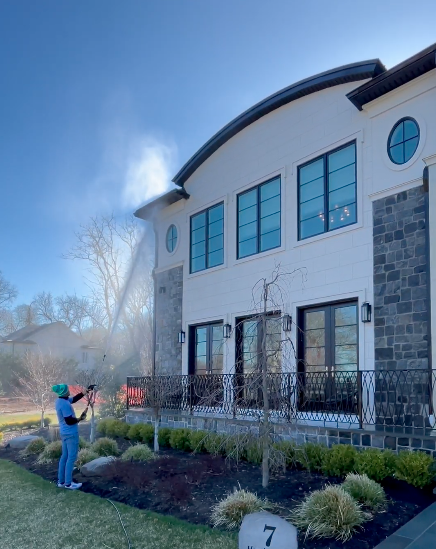
- Exterior power washing. Common area walkways, entryways, mailbox areas, community amenity buildings, pool decks (before winter closure). See commercial power washing service.
- Rooftop solar panel cleaning if the building has solar arrays. See commercial solar cleaning schedules.
- Community amenity building windows. Clubhouse, gym, pool building, mail room, community meeting spaces.
- Retaining wall and masonry cleaning. Common in Bergen County condo complexes — algae buildup and stain removal before winter.
- Landscape hardscape cleaning. Walkway pavers, patio pavers, retaining walls. Consider re-sealing pavers per paver sand and seal guide.
- Winter access prep. Handrails, exterior stairs, lobby entry paths.

Real Budget Benchmarks for Bergen County HOAs (2026)
Every property is different, but here are real ranges for Bergen County HOA fall exterior work in 2026:
- Small townhouse HOA (10–30 units): $1,500–$4,500 for fall exterior scope. Common area windows, gutters, entry power washing.
- Mid-size condo association (30–100 units): $4,000–$12,000. Adds common areas, amenity buildings, walkway/entry hardscape.
- Large condo complex (100–300 units): $10,000–$30,000+. Full exterior scope across multiple buildings, amenity spaces, extensive common areas.
- Luxury or mixed-use associations (300+ units): Custom-quoted. Often includes specialty scope — rooftop solar, ground-mount solar, extensive hardscape, historic masonry.
These ranges are for the fall exterior maintenance push only. Annual maintenance contracts covering the full year run 3–4x these numbers depending on frequency.
The HOA Fall Exterior RFP: What to Include
A vague RFP gets vague quotes. A specific scope gets bids you can actually compare. Real RFP scope items:
- Property inventory. Number of buildings, unit count, common area square footage, exterior glass counts.
- Scope by area. Windows: what floors, what buildings. Gutters: which buildings, linear feet. Power washing: which surfaces, square footage.
- Frequency specification. One-time fall pass? Or fall + spring? Or quarterly?
- Access and coordination requirements. Loading dock hours, elevator access, resident notification procedures, quiet hours.
- Insurance requirements. Minimum $2M general liability, workers’ comp, umbrella coverage, additional insured naming, certificate of insurance.
- Fall protection compliance for anything above ground floor. Non-negotiable.
- Product and technique restrictions. Any eco-friendly product requirements, any surface-specific technique requirements (soft wash vs pressure wash on specific materials).
- Timeline expectations. Start-by date, complete-by date, weather contingency plan.
- Reporting requirements. Before/after photos, completion sign-off procedure, damage reporting protocol.
- Storm response clause. Response time, priority scheduling, pricing for storm-related emergency work.
- Contract term. Single-year, multi-year, auto-renew?
- Payment terms. Deposit, progress, completion. Net 30, net 45.
The broader B2B contract structure lives in our property manager window cleaning contract checklist. HOA-specific additions:
- Board approval workflow. Which board members sign off, in what order.
- Resident communication. How and when residents are notified before work.
- Reserve fund vs operating budget attribution. Some scope items may hit reserves rather than the operating budget.
- Bylaws compliance. Some HOAs have specific bylaws about vendor selection, competitive bidding requirements, or minimum insurance limits.
The Storm Response Clause
Bergen County winter storms are real. Every year associations end up needing exterior response work — post-nor’easter cleanup, ice-damage window cleaning, downed-branch removal from common areas, storm-damaged gutter emergency service. Without a contracted vendor in place, you’re either:
- Paying premium emergency rates from a vendor you haven’t vetted (and hoping they’re actually licensed and insured), OR
- Waiting days for vetted vendors who are overbooked with other emergency work
A storm response clause in your fall contract locks in:
- Response time commitment. Typical for HOA contracts: 24-hour on-site response for exterior emergency work.
- Priority scheduling. Contracted associations get scheduled before one-off callers.
- Storm pricing. Emergency work rate defined in advance. No surprise bills after the fact.
- Scope pre-approval. Board doesn’t need to reconvene for routine storm response items — vendor can execute up to a pre-defined dollar threshold and report after.
Our Bergen County posts on post-storm response — post-storm window cleanup — cover what the response actually involves.
Vetting Bidders
- NJ Home Improvement Contractor (HIC) license verified. Non-negotiable.
- General liability $2M per occurrence / $5M aggregate minimum for association work.
- Umbrella coverage $5M+ for larger complexes.
- Workers’ compensation current and verifiable.
- Certificate of insurance with the association named as additional insured. Real certificate, current dates.
- OSHA fall protection compliance for above-ground-floor work. Written safety plan on file.
- Real Bergen-area address and phone number. Not a virtual office or answering service.
- Association references. Ask for 3 other Bergen County HOA or condo associations they currently service.
- Financial stability. For multi-year contracts, verify the vendor will still be operating in year 2 and 3. Ask about business tenure.
- Board reference calls. Actually call the reference associations. Ask about responsiveness, reliability, storm-response performance.
Red Flags in HOA Exterior Bids
- Quote without a walk-through. Real HOA quotes require an on-site walkthrough — vendors that quote from Google Maps are missing scope.
- Lump-sum quote without itemization. Nothing to compare against other bids.
- Insurance limits below RFP specification. Automatic disqualifier.
- No fall protection documentation.
- Aggressive price undercutting the other bids. Usually means missing scope, insufficient insurance, or under-scoped labor.
- Verbal-only storm response commitment. If it’s not in writing, it doesn’t exist.
- Refusal to sign the association’s contract terms. Vendors that only work off their own paper are managing their liability at the association’s expense.
The Fall RFP Timeline
- Early August: Board finalizes scope. Property manager circulates RFP to shortlist.
- Mid-August to early September: Vendor walk-throughs and quotes returned.
- Mid-September: Bid review, reference calls, board discussion.
- Late September: Vendor selection and contract execution.
- October–early November: Fall exterior work executed. Storm response clause active.
- Late November: Final work completion, invoice review, contract renewal discussion for next year.
Boards that push this timeline earlier — starting the RFP in June rather than August — often lock in better rates and preferred scheduling. Vendors have more availability before peak fall season starts.
Related Reference Material
- Fall exterior cleaning checklist for Bergen County homes — the underlying scope items across each surface.
- Property manager window cleaning contract checklist — broader B2B contract structure.
- Commercial solar panel cleaning for NJ property managers — if your association has rooftop solar.
- Bergen County post-storm window cleanup guide — storm response scope.
The Bergen County government website provides resources for consumer protection contractor verification and any building/permit questions boards might have.
Ready to RFP Your Bergen County HOA Fall Exterior Work?
If your Bergen County HOA, condo association, or property management team is putting together fall exterior maintenance bids for the 2026 season, we’d be happy to walk the properties, review your scope, and put together a proposal that covers the full exterior maintenance cycle — windows, gutters, power washing, solar, hardscape, storm response. Multi-year contracts and portfolio pricing available for property managers running multiple associations.
Our commercial window washing service and commercial power washing service cover the core exterior scope. Request a free walk-through and proposal and we’ll follow up with itemized pricing, timeline, and a written scope your board can approve.